
Your needs, this model
Does it fit your priorities?
Can I hold an 80°C recipe for one hour?
Yes. 80°C equals 176°F within the one-degree Hold range; restart Hold after pouring.
Explore this need in the finder →Can Boil and Keep Warm run together?
No. The manual disables Hold when the Boil button is used.
Explore this need in the finder →Can I heat a 1.5 L batch?
No. This is a 1.0 L kettle.
Explore this need in the finder →A gooseneck with two different routes to hot water
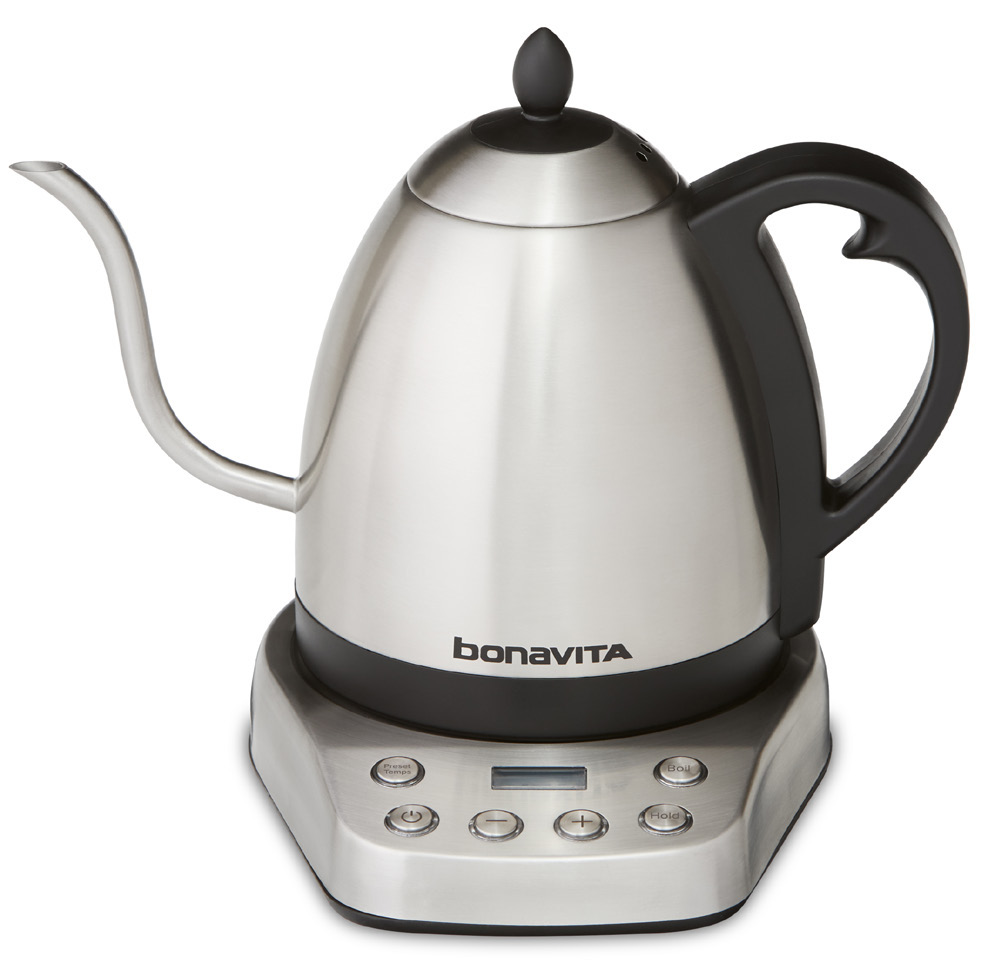
The Bonavita Interurban BV07002US suits a brewing routine built around directed pouring, numerical temperature selection and local buttons. Its one-liter jug sits on a stainless steel control base with a dedicated Boil key. That key is the most consequential distinction in its operation: adjustable heating can use an optional hour of Hold, while the separate boiling mode disables Hold. Choose it when that division fits your routine, especially if you are comfortable pressing Hold again after pouring.
The current official stainless-steel offer identifies BV07002US. This is an Interurban configuration, separate from the classic Bonavita variable-temperature kettle. Similar appearance and replacement-base compatibility do not make the control arrangements identical. Check the exact model when comparing an offer or a replacement part.
Recipe control below boiling
The official product reference gives manual selection from 140°F to 208°F in one-degree increments. There are also six shortcuts at 140, 176, 185, 190, 205 and 208°F. These cover familiar brewing starting points without limiting you to those buttons. For example, an 80°C recipe corresponds exactly to 176°F, an offered setting within the adjustable range.
The manual permits switching between Fahrenheit and Celsius. During ordinary adjustable heating, the screen first flashes the selected target and then reports current water temperature. That is useful if you want to observe progress or see how much cooling has occurred. Selection and readout still do not constitute an independent accuracy test; this assessment does not claim laboratory confirmation of water temperature.
Boil is a separate action
For boiling, the Interurban provides its own Boil button. The manual describes this mode as responding to the local boiling point, which matters because altitude changes that point. The screen says BOIL during that cycle and returns to a temperature reading afterward. The preceding manual setpoint does not become the boil target.
Holding is disabled while this button is in use. Therefore a request for boiling plus active holding cannot be satisfied by borrowing Hold from the other mode. The one-degree manual range ends at 208°F, below the familiar sea-level 212°F figure. Someone who requires an exact 100°C selected setting maintained for an hour needs a different documented arrangement.
Holding and pouring need a short reset step
Within the adjustable range, Hold can maintain the chosen temperature for up to 60 minutes. It is optional. After lifting the jug and returning it to the base, press Hold again if you want continued heating. The screen can remain useful without the heater maintaining the target, so a temperature number alone is not confirmation that Hold is active.
The base also offers a count-up stopwatch after lifting, started with the plus button, with a seven-minute maximum. That can help organize a brewing sequence, but it does not automate pouring or promise a particular extraction. Think about where the base sits relative to your dripper and whether its display is easy for you to see while working.
One liter, an internal scale and a lift-off lid
The gooseneck shape is intended for directing a narrow stream over grounds. This is a pouring-purpose assessment, not a firsthand flow-rate or balance test. One liter can cover a substantial brewing job, but any rinse water and vessel warming comes from the same fill. It cannot meet a requirement for at least 1.5 L in one batch.
The water indicator is inside the jug and the lid lifts off completely. The numerical minimum fill is not established in the material read, so no arbitrary one-mug minimum is promised. Bonavita describes stainless steel and BPA-free plastic, which should not be translated into an entirely plastic-free appliance. The exact original manual establishes a 120 V, 60 Hz, 1000 W edition.
Where the Interurban fits
Let the kettle cool before cleaning and follow its descaling directions when mineral buildup appears. Keeping the base and connectors dry remains part of care even with a metal base. The Cuisinart GK-1 is a useful alternative to compare for a different local gooseneck control layout. The Interurban is strongest when one-liter capacity, live readout and lower-temperature Hold solve the actual brewing job. Its official product reference supplies the current identity; the original manual explains the mode and lift-return limits.
Key details at a glance
| Controlled-pour gooseneck | Yes |
|---|---|
| General-purpose spout | No |
| Selectable temperature | Yes |
| Live temperature readout | Yes |
| Fahrenheit display | Yes |
| Celsius display | Yes |
| Completely removable lid | Yes |
| External water-level window | No |
| Tea infuser included | No |
| Nominal maximum capacity | 1 L |
| Maximum documented hold duration | 60 min |
| Rated input power | 1000 W |
| Documented supply voltage | 120 V |
| Pouring arrangement | Gooseneck; seven-minute maximum count-up stopwatch can start after lifting. |
| Temperature controls | Manual Fahrenheit selection 140–208 in one-degree steps; dedicated altitude-responsive Boil button; F/C display and current-water readout. |
| Holding routine | Optional selected-temperature Hold up to 60 minutes; press Hold again after pouring; disabled in Boil mode. |
| Water-contact material details | Maker describes brushed stainless steel and BPA-free plastic; not a complete plastic-free claim. |
| Care and access | Lift-off lid and internal marks; clean and dry, descale when mineral buildup appears following maker instructions. |
| Electrical edition and base | Original Interurban manual establishes 120 V, 60 Hz and 1000 W; household use supported. |
Use the exact model’s instructions for operating limits, supplied equipment and version differences.
Sources for this assessment
Find a kettle for your daily routine.
Compare pouring style, batch capacity, temperature controls and the details that matter to you.