
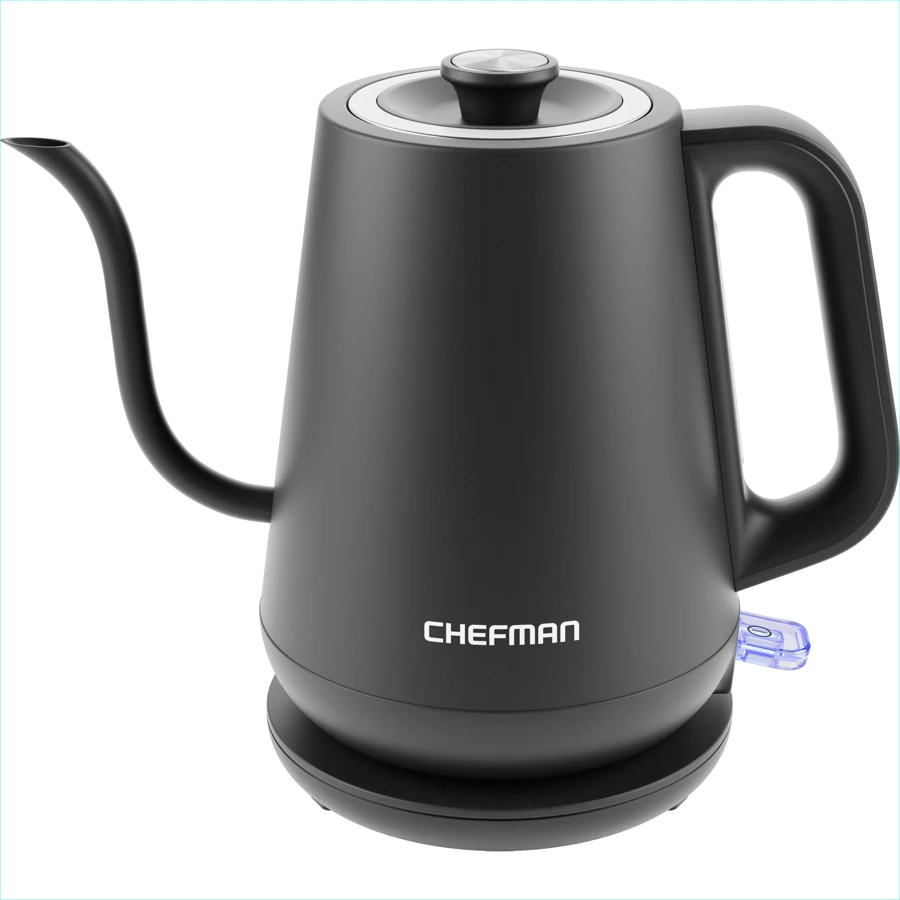
Your needs, this model
Does it fit your priorities?
Can this make a small, controlled pour-over batch?
Yes, within its 0.5–0.8 L operating fill range. The narrow spout provides a directed stream; it does not add a selectable brewing temperature.
Explore this need in the finder →Can I heat just 300 ml for one drink?
No. Chefman specifies a 0.5 L minimum for this exact model, even though the maximum is only 0.8 L.
Explore this need in the finder →Will it show the actual temperature as it heats?
No. The blue switch light is a heating indicator, not a numeric temperature display.
Explore this need in the finder →A small pour-over kettle with a visible fill window
The RJ11-GN-BLACK fits a particular routine: heat a modest batch, then pour through a narrow spout without working through a temperature menu. Its 0.8-liter maximum makes sense for a small pour-over setup. The external viewing window is a useful distinction if you prefer to check the water level without removing the lid.
The main compromise is the limited operating range. Chefman specifies a 0.5-liter minimum, so this is not a kettle for heating any tiny single-cup quantity. Its on/off switch also means you boil water rather than choose a below-boiling target on the base. Those two details should decide its place on your shortlist.
Choose it for the stream, rather than extra controls
A gooseneck directs water through a narrow outlet. For someone moving around a coffee bed, that shape is more relevant than an oversized capacity or several tea presets. The manual describes a controlled pour. Its practical role is directing the stream around the coffee bed rather than filling a large vessel with a broad rush of water.
For filling a large teapot or several vessels quickly, consider an ordinary general-purpose spout instead. A focused pouring shape is worthwhile when you intend to use it. It is less persuasive if most of your hot water simply goes into a large pot and you value a bigger batch.
The 500 ml minimum matters as much as the 800 ml maximum
The manual places the MIN line at 0.5 L and the MAX line at 0.8 L on the viewing window. This gives you a clear range to work within. Measure the water required by your own coffee recipe rather than assuming that a small kettle automatically permits a very small fill.
A 300 ml heating requirement does not fit the documented minimum. A 500 ml batch does. Likewise, a recipe requiring a full liter cannot fit into one cycle. That is a more useful way to judge capacity than translating the kettle into a fixed number of cups, because mugs and brewing recipes vary.
A boil switch is not a temperature setting
After filling and securing the lid, you set the kettle on its powered base and press the switch down. The blue light illuminates during heating. Once the water boils, the switch returns to off and the light goes out. There is no numeric temperature readout in this control arrangement.
If your routine requires pressing an exact temperature setting and returning to held water later, look for those actual controls elsewhere. Letting boiled water cool is a separate manual routine; the RJ11-GN-BLACK does not measure or select that cooling endpoint for you. Its simplicity is helpful only if that matches how you make your drink.
Filling and serving are separate from heating
The lid removes completely for filling and access to the inside. The kettle can sit on the base from different directions, which lets you orient the handle for your work area. Lifting it away leaves the electrical lead behind for serving; it does not provide battery-powered heating away from the base.
Chefman describes the handle as cool-touch, while the guide warns that the kettle body becomes hot. Use the handle and keep the lid closed during pouring. A stainless-steel exterior should not be mistaken for insulation, nor does it establish that every water-contact component is metal: this model expressly includes a viewing window.
Plan for regular care
Unplug and cool the kettle before cleaning. The guide calls for hand cleaning, prohibits dishwasher cleaning, and keeps the electrical base, plug and cord out of water. The removable lid helps with access, but it does not change those restrictions.
Mineral deposits require descaling using the method in this exact guide. The frequency depends on your water and use. Keep the fill limits in mind even when following a cleaning process; do not improvise a concentrated mixture or assume the instructions for a different Chefman kettle are interchangeable.
Check the full model code
Choose this version when the viewing window, 0.5–0.8 L fill range and simple boiling switch suit you. Chefman also lists RJ11-GN-BLK-V2, a separate model reference. Compare that version’s own fill and feature instructions rather than assuming that similar black gooseneck styling guarantees identical construction.
Chefman’s RJ11-GN-BLACK product reference and exact user guide, especially pages 2 and 7–9, support the features and limits discussed here.
Key details at a glance
| Controlled-pour gooseneck | Yes |
|---|---|
| General-purpose spout | No |
| Selectable temperature | No |
| Live temperature readout | No |
| Fahrenheit display | No |
| Celsius display | No |
| Completely removable lid | Yes |
| External water-level window | Yes |
| Tea infuser included | No |
| Nominal maximum capacity | 0.8 L |
| Documented minimum fill | 500 mL |
| Rated input power | 1000 W |
| Documented supply voltage | 120 V |
| Pouring arrangement | Narrow gooseneck for a controlled stream; external viewing window shows MIN 0.5 L and MAX 0.8 L. |
| Temperature controls | One on/off boiling switch; blue status light, no numeric target or live display. |
| Holding routine | Switch automatically turns off at boiling; no keep-warm control in the documented operating sequence. |
| Water-contact material details | Manufacturer describes a stainless-steel kettle with a water-viewing window; this is not an all-metal-water-path claim. |
| Care and access | Hand clean after cooling; no dishwasher or immersion of the powered base, cord or plug. Follow the exact guide for descaling. |
| Electrical edition and base | 1000 W/120 V household kettle; the jug lifts off its mains-powered base. |
Use the exact model’s instructions for operating limits, supplied equipment and version differences.
Sources for this assessment
Find a kettle for your daily routine.
Compare pouring style, batch capacity, temperature controls and the details that matter to you.