
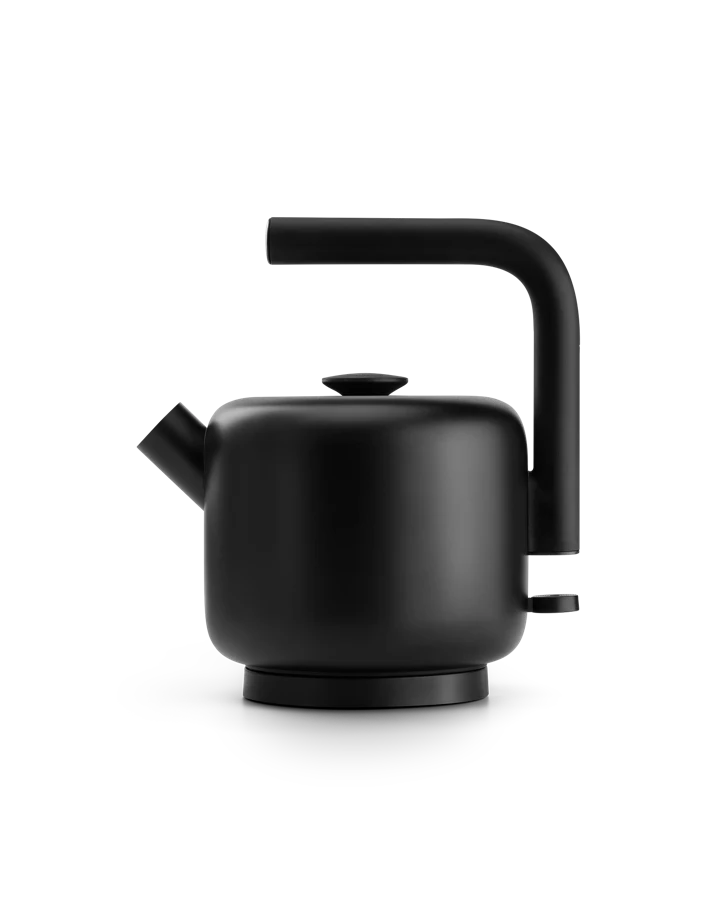
Your needs, this model
Does it fit your priorities?
Is Clyde the Fellow to compare for a 1.5-liter everyday boiling batch?
Yes. Its 1.5-liter maximum and general-purpose spout suit that broad job, with a single-switch boiling cycle. Respect the actual fill marks rather than assuming every cup has the same volume.
Explore this need in the finder →Can I heat half a liter and lift the lid off for filling?
Yes. The North American manual sets a 500 mL minimum and describes removing the lid after it has cooled. Follow the fill marks and keep the powered base dry.
Explore this need in the finder →Does Clyde give me 90°C water held for half an hour?
No. It provides automatic boiling rather than selected-temperature holding. Compare a temperature-control model when that combination matters.
Explore this need in the finder →For a household that mostly wants boiling water
The Fellow Clyde is the straightforward choice in Fellow's electric-kettle range when your routine is filling a teapot, making several drinks or getting hot water ready for a meal. It has a 1.5-liter capacity and a conventional pouring spout, rather than a narrow pour-over gooseneck. The relevant buying question is whether you want this simpler boiling routine or the selectable temperatures and holding controls of an EKG model.
This assessment concerns the North American Clyde, with matte-black shop code ECLMB-NA. A finish choice does not turn it into a different heating system. Choose the physical configuration for its use, then choose the color you prefer; there is no reason to expect a different temperature capability from a different paint finish.
Capacity without a temperature menu
A 1.5-liter maximum is useful when a smaller pour-over kettle would need a refill before everyone has a drink. It is still a nominal water capacity, not a universal count of mugs. Measure the amount your own cups or teapot actually require and follow the fill marks. The North American manual requires at least 500 mL per cycle. A smaller drink still needs that minimum in the jug; do not heat a tiny quantity simply because it is all you intend to pour.
Clyde's attraction is the switch-operated boiling process. You are not paying for a setpoint screen simply to turn the water on each morning. The other side of that simplicity is that a drink needing a specific lower temperature deserves an appropriately selectable kettle, or a separate measured preparation routine. Automatic boiling and automatic shut-off should not be confused with choosing and maintaining a lower setpoint.
A spout for general pouring
The maker describes Clyde's spout as drip-free and its heat-resistant handle as helping a comfortable pour, including with a full jug. These are design claims, not results from a pouring test performed here. They identify the intended job: moving a useful quantity into a cup, pot or cooking vessel without the deliberately restricted flow of a gooseneck.
That is a sensible difference if several people share one kettle for drinks and meals. It is less convincing if your main pleasure is carefully placing a narrow stream over a coffee bed. For that routine, compare a genuine gooseneck first. A general-purpose spout is not a worse version of a specialist spout; it solves a different pouring task.
Understand the material claim
The documented construction includes a 304 stainless-steel kettle body, a plastic base and lid surface, and a silicone-overmolded handle. A stainless body is a useful description of the vessel, but it does not establish that every part contacting water or steam is metal. Likewise, a heat-resistant handle does not promise that all exposed surfaces remain cool.
If avoiding a particular material is essential, ask about the specific water and steam path rather than treating an exterior photograph as a complete materials diagram. Keep your hands on the intended handle, leave space for steam when filling and pouring, and follow the appliance's own instructions. The manual prohibits immersion and dishwasher cleaning. Wipe the cooled, unplugged kettle and base with a soft damp cloth and dry them. For scale, follow Fellow's descaling directions and use a soft sponge or brush rather than abrasive steel wool. A minimal design still needs care.
Allow room for the whole setup
The lid lifts off for filling once it has cooled, and the kettle lifts from its powered base for pouring; it does not heat water from an internal battery. The North American reference specifies 120 V and 1500 W. Plan where the base will sit in relation to an appropriate outlet and the area you need for filling and opening the lid. The documented three-foot cord should be treated as a placement constraint, not a reason to trail cable through a wet work area.
Fellow publishes dimensions of 9.7 × 7.1 × 10.5 inches for the appliance. When considering counter space, look beyond the jug's appearance in a product picture. You need room for the complete kettle and base, your hand on the handle and unobstructed lid access. A model that suits the visible gap but is inconvenient to fill will be irritating in daily use.
When Clyde is the right tradeoff
Choose Clyde when a larger general-purpose boiling kettle fits your actual day better than a smaller brewer's tool. Its appeal is a direct switch, useful nominal capacity and a spout meant for ordinary pouring. Compare a selectable-temperature model if different teas, measured brewing targets or holding water at a chosen setting are central to your routine.
Judge it by that complete workflow rather than assuming the Fellow name means every EKG feature comes along. The successful purchase is a kettle you can fill, heat and pour comfortably in your kitchen, with the controls you actually need and no expectation of an unprovided brewing function.
Manufacturer references: Clyde specifications and FAQ; Clyde operation and care guide.
Original North American instructions: fill limits, exact model and care; switch-operated boiling guide.
Key details at a glance
| Controlled-pour gooseneck | No |
|---|---|
| General-purpose spout | Yes |
| Selectable temperature | No |
| Live temperature readout | No |
| Fahrenheit display | No |
| Celsius display | No |
| Completely removable lid | Yes |
| Tea infuser included | No |
| Nominal maximum capacity | 1.5 L |
| Documented minimum fill | 500 mL |
| Rated input power | 1500 W |
| Documented supply voltage | 120 V |
| Cord length | 36 in |
| Pouring arrangement | Wide general-purpose spout for cups, teapots and water for meal preparation. |
| Temperature controls | One LED switch starts an automatic boiling cycle; no selectable lower-temperature menu or live numerical temperature display. |
| Holding routine | Automatic boiling shut-off; not a selected-temperature holding arrangement. |
| Water-contact material details | 304 stainless body; plastic base/lid surface and plastic handle endcaps with a food-grade silicone overmold. No entirely metal water-path claim. |
| Care and access | No immersion or dishwasher parts. After cooling and unplugging, wipe the kettle and base with a damp soft cloth, dry, and descale as instructed. |
| Electrical edition and base | North American manual: 120 V, 1500 W and 60 Hz, with a grounded three-prong plug. Use the matching Clyde powered base. |
Use the exact model’s instructions for operating limits, supplied equipment and version differences.
Sources for this assessment
Find a kettle for your daily routine.
Compare pouring style, batch capacity, temperature controls and the details that matter to you.