
Your needs, this model
Does it fit your priorities?
Can I keep water ready while making several small pour-over batches?
Yes. Its gooseneck and selected-temperature hold fit that routine, with 15–60-minute choices. Keep at least 333 mL in the kettle and recheck the level before it resumes heating.
Explore this need in the finder →Can I see the current water temperature in Celsius while using a 90°C setting?
Yes. The Pro shows live temperature and supports Celsius; the guide explicitly documents half-degree Celsius selection, which includes 90°C. A control setting is not a laboratory accuracy guarantee.
Explore this need in the finder →Will this cover a full one-liter batch for a large carafe?
No. The maximum is 0.9 L. If one liter in one cycle is essential, choose a larger kettle rather than filling above its limit.
Explore this need in the finder →A specialist kettle when the pour matters
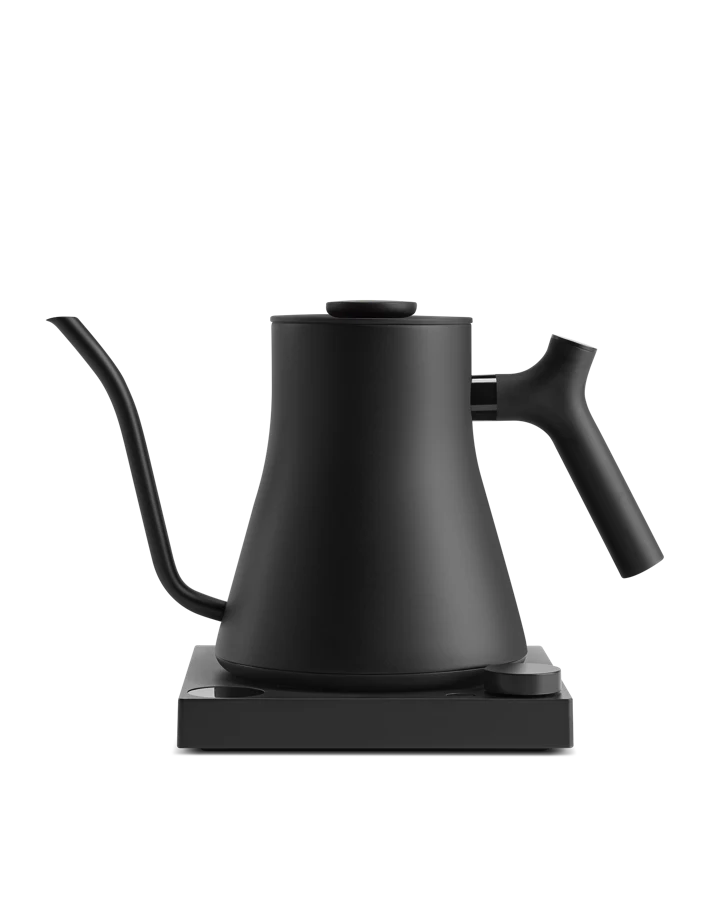
The Fellow Stagg EKG Pro is the right style of kettle to investigate when your main task is placing a controlled stream over a coffee bed. Its gooseneck serves that deliberate pouring routine, while the temperature controls let you return to a chosen setting. The 0.9-liter capacity makes more sense for a brewer's batch than for a household expecting a large pot of water on every cycle.
This assessment follows the US Pro configuration, including matte-black shop code 1222PRO-MB-US. The standard Pro is distinct from the Pro Studio Edition and from an original Stagg EKG without the Pro controls. A shared product-page name or a new finish should not erase those hardware and control differences.
Start with the spout, then choose the controls
A gooseneck is useful because of the pouring job it supports, not because a narrow spout automatically makes every cup taste better. If you want to build a repeatable pour-over routine, it gives you a different tool from a wide general-purpose kettle. Your grinder, recipe and technique still matter; this is not a taste test or a promise of a particular extraction result.
If your usual task is quickly filling a teapot, warming cooking water or making several ordinary drinks, compare a general-purpose spout before paying for specialist pouring. Fellow's Corvo models address that broader pouring role. The sensible starting question is how you will move the water, rather than which kettle has the longest feature list.
Selectable heating and a visible temperature
The Pro's documented target range is 104–212°F, or 40–100°C, with Fahrenheit and Celsius display choices. A live temperature readout is useful when you want to see the heating process instead of relying only on an indicator light. Remember that choosing a setting and measuring the water with a calibrated instrument are different things; the selected target is not an independent accuracy result from this review.
The maker's get-to-know guide explicitly describes half-degree Celsius adjustment, while the current comparison table describes 0.5°F increments. These are offered settings, not measured accuracy figures. Choose the displayed unit you use in your recipe, and check the actual control rather than assuming an arbitrary decimal is available. Set the altitude option appropriately because water boils at a lower temperature at higher elevations.
Holding water changes a multi-pour routine
The documented hold choices are 15, 30, 45 or 60 minutes. This is useful if your brewing sequence includes pauses or you make a second drink shortly after the first. Select the duration that fits your actual routine rather than assuming the longest possible hold is always desirable.
The US manual requires at least 333 mL and says the kettle starts heating toward the goal immediately when returned to the powered base. Check the remaining level after pouring, especially before another hold period. A holding mode does not mean you can ignore a low water level or leave a kettle indefinitely ready. For a single quick drink, straightforward heating may be enough; for several pours, the hold controls become a more meaningful reason to choose the Pro.
Scheduling is a convenience to use deliberately
The Pro reference includes scheduled heating to a selected temperature. This can make a regular morning routine easier, provided the kettle has been filled and set up correctly beforehand. Scheduling does not turn the jug into a plumbed water supply and should not substitute for checking the lid, fill level and safe counter position.
Nor should a firmware-update connection be sold as remote kettle operation. The relevant convenience is the scheduling and control behavior the kettle itself supports. Choose it for a routine you can actually use, rather than imagining a phone-controlled function that has not been offered.
Capacity and cleaning are part of precision
The 0.9-liter maximum is below one liter. It may comfortably cover your own brewing batch, but it does not satisfy a larger nominal-capacity requirement simply because it is marketed to serious coffee drinkers. Check the water your recipe and serving vessel actually need, and follow the minimum and maximum fill marks.
The lid lifts off for filling and cleaning, but wait until it has cooled before removal. Use fresh water only. No part is dishwasher-safe: wipe the exterior and base, keep electrical parts out of water, and follow Fellow's descaling instructions. The 304 stainless vessel does not establish that every water or steam contact is metal. A temperature screen does not prevent scale accumulation.
Who should choose the standard Pro?
Choose Stagg EKG Pro when controlled gooseneck pouring, selectable heating and a useful hold schedule fit your brewing. The standard Pro is the logical comparison point before considering a Studio finish and base upgrade. Choose a larger or wider-spout model if volume and everyday serving are the real priorities. Its value comes from fitting the way you brew, not from guaranteeing a result the rest of your process has yet to achieve.
Manufacturer references: product details and current controls; US fill limits and care instructions.
Key details at a glance
| Controlled-pour gooseneck | Yes |
|---|---|
| General-purpose spout | No |
| Selectable temperature | Yes |
| Live temperature readout | Yes |
| Fahrenheit display | Yes |
| Celsius display | Yes |
| Completely removable lid | Yes |
| Tea infuser included | No |
| Nominal maximum capacity | 0.9 L |
| Documented minimum fill | 333 mL |
| Maximum documented hold duration | 60 min |
| Cord length | 30 in |
| Pouring arrangement | Narrow gooseneck for deliberate pour-over pouring; not a fast general-purpose spout. |
| Temperature controls | 40–100°C / 104–212°F target range. The get-to-know guide explicitly supports half-degree Celsius adjustment; the current maker comparison describes 0.5°F increments. Settings do not establish measured accuracy. |
| Holding routine | Choose 15, 30, 45 or 60 minutes. The US manual says returning the kettle to its powered base starts heating to the goal temperature immediately; recheck fill before restarting. |
| Water-contact material details | 304 18/8 stainless-steel vessel with plastic handle/lid components; this is not an all-metal water-and-steam-path certification. |
| Care and access | Remove the lid only after cooling. Wipe and dry the kettle/base; no immersion or dishwasher parts. Descale as instructed with an appropriate scale remover. |
| Electrical edition and base | US manual specifies 110–120 V AC, 1000–1200 W and 50–60 Hz with a grounded three-prong supply. |
Use the exact model’s instructions for operating limits, supplied equipment and version differences.
Sources for this assessment
Find a kettle for your daily routine.
Compare pouring style, batch capacity, temperature controls and the details that matter to you.