
Your needs, this model
Does it fit your priorities?
Does Studio give me a different pour-over temperature range from standard Pro?
The reviewed Studio and standard Pro share the documented 40–100°C range and hold choices. Choose Studio for the glass base and finishing details, rather than assuming a separate taste or accuracy advantage.
Explore this need in the finder →Can I make a 350 mL batch and keep it ready for 45 minutes?
Yes, 350 mL is above the 333 mL documented minimum and below the 0.9 L maximum. Select the 45-minute hold and keep checking the level after each pour.
Explore this need in the finder →Is this the larger 1.5-liter Fellow for a shared teapot?
No. Studio still holds at most 0.9 L and has a gooseneck. A larger general-spout kettle is the better category to compare for that job.
Explore this need in the finder →The Studio choice is about the object you use every day
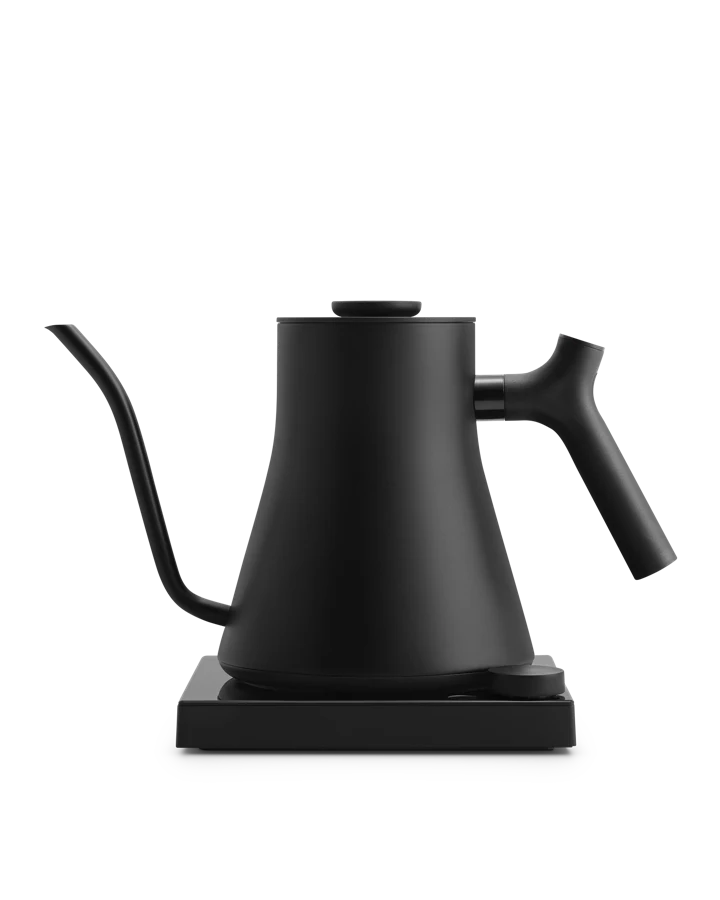
The Fellow Stagg EKG Pro Studio Edition makes sense when you already want the Stagg Pro's controlled pour-over routine and place extra value on the base and finishing details. It remains a 0.9-liter gooseneck kettle with selectable heating and holding controls. The Studio Edition should be compared with the standard Pro as a construction choice, rather than assumed to brew better coffee merely because its appearance is more refined.
This review concerns the matte-black US Studio configuration, shop code 1220PROS-MB-US. Fellow lists it separately from standard Pro code 1222PRO-MB-US. That is a documented edition distinction, not a new review created just for a different color. Conversely, a different color within the same hardware edition does not automatically create a new heating system.
First decide whether you need a gooseneck
The narrow spout is the central practical choice. It serves the deliberate placement and controlled stream many pour-over routines require. Choose it because you want that kind of pouring, not simply because a coffee accessory looks more sophisticated on the counter. A wide-spout kettle is often the more direct tool for filling an ordinary teapot or moving water quickly into a cooking vessel.
The Studio finish does not change this basic tradeoff. If you mostly make several general-purpose drinks, investigate Corvo or another wider-spout model before deciding how much finishing detail you want. The wrong pouring style remains the wrong choice even in an attractive upgraded enclosure.
What the Studio hardware adds
The Studio reference identifies a reflective glass base and refined metal accents. These are meaningful differences in the part you see and touch while selecting a setting. They may matter if you prefer a particular finish, tactile feel or arrangement alongside other equipment. They are not evidence of a separately measured heating accuracy, different coffee taste or longer service life.
Think about the way the base will be used and cleaned. Water drips, fingerprints and the space around a brewing scale can matter more to daily satisfaction than a picture of an empty counter. Use the cleaning instructions appropriate to the actual materials, keep the powered base dry, and avoid assuming a premium-looking surface tolerates aggressive cleaners.
Heating and holding remain the functional reasons to choose Pro
The documented target range is 104–212°F, or 40–100°C, with Fahrenheit and Celsius display choices and a live temperature readout. The guide describes half-degree Celsius adjustment, and the current product comparison states 0.5°F increments. These let you build a repeatable preparation routine without treating boiling as the only available heating endpoint. An offered setting is still a control target, not an independent measurement of water accuracy from this review.
The hold choices are 15, 30, 45 or 60 minutes. They are useful when brewing includes a pause, or when another person makes a drink shortly afterwards. Choose a duration around that routine rather than expecting the kettle to remain indefinitely ready. The US manual says it resumes heating to the goal as soon as it is returned to the powered base. Recheck the remaining water before doing so; the minimum is 333 mL.
Scheduling and firmware updates
Scheduled heating is part of the documented Pro feature set. It can be useful when your routine starts at a predictable time and the kettle has been prepared properly beforehand. It is not automatic filling, and it does not remove the need to check the water level and safe placement.
Fellow's firmware-updating connection should also be distinguished from remote heating control. A phone connection used to maintain software is not permission to advertise control from another room or away from home. If connectivity is your deciding requirement, look at the exact offered function rather than the presence of an app name.
The small-batch limit still applies
The maximum capacity remains 0.9 liters. A larger finish budget does not turn it into a one-liter or 1.5-liter kettle. Check the total water needed for your brewing recipe and serving vessel, including any extra preparation water you normally use, while respecting the marked maximum.
A drink needing only 250 mL does not remove the 333 mL minimum-fill requirement. Heat at least that amount, then pour what you need. The fully removable lid gives filling access once the kettle has cooled; no part is dishwasher-safe. Wipe and dry the base rather than immersing it, and deal with scale according to Fellow's care instructions. This is a water kettle, not a vessel for brewing loose ingredients inside.
Choose the upgrade for the right reason
Shortlist the Pro Studio Edition if the Stagg Pro workflow already fits and its documented base and finishing differences are worth the upgrade to you. Choose the standard Pro if your priority is that brewing routine with its core temperature and hold functions. Choose a different spout or larger jug when those practical needs lead elsewhere. Studio is a considered material preference, not a substitute for choosing the right kettle first.
Manufacturer references: Pro Studio details and edition comparison; US Pro and Studio safety manual.
Key details at a glance
| Controlled-pour gooseneck | Yes |
|---|---|
| General-purpose spout | No |
| Selectable temperature | Yes |
| Live temperature readout | Yes |
| Fahrenheit display | Yes |
| Celsius display | Yes |
| Completely removable lid | Yes |
| Tea infuser included | No |
| Nominal maximum capacity | 0.9 L |
| Documented minimum fill | 333 mL |
| Maximum documented hold duration | 60 min |
| Cord length | 30 in |
| Pouring arrangement | Narrow gooseneck for deliberate pour-over pouring; not a fast general-purpose spout. |
| Temperature controls | 40–100°C / 104–212°F target range. The get-to-know guide explicitly supports half-degree Celsius adjustment; the current maker comparison describes 0.5°F increments. Settings do not establish measured accuracy. |
| Holding routine | Choose 15, 30, 45 or 60 minutes. The US manual says returning the kettle to its powered base starts heating to the goal temperature immediately; recheck fill before restarting. |
| Water-contact material details | 304 18/8 stainless-steel vessel with plastic handle/lid components; this is not an all-metal water-and-steam-path certification. |
| Care and access | Remove the lid only after cooling. Wipe and dry the kettle/base; no immersion or dishwasher parts. Descale as instructed with an appropriate scale remover. |
| Electrical edition and base | US manual specifies 110–120 V AC, 1000–1200 W and 50–60 Hz with a grounded three-prong supply. |
Use the exact model’s instructions for operating limits, supplied equipment and version differences.
Sources for this assessment
Find a kettle for your daily routine.
Compare pouring style, batch capacity, temperature controls and the details that matter to you.