
Your needs, this model
Does it fit your priorities?
Can I require gooseneck pouring and a 250 mL fill?
Yes. The manual minimum is 237 mL, with a 591 mL maximum.
Explore this need in the finder →Can I heat 200 mL?
No. That is below the documented 237 mL minimum.
Explore this need in the finder →Can it hold a selected coffee temperature?
No. It is a boil-only gooseneck with no active hold.
Explore this need in the finder →A very small gooseneck for boiling and deliberate pouring
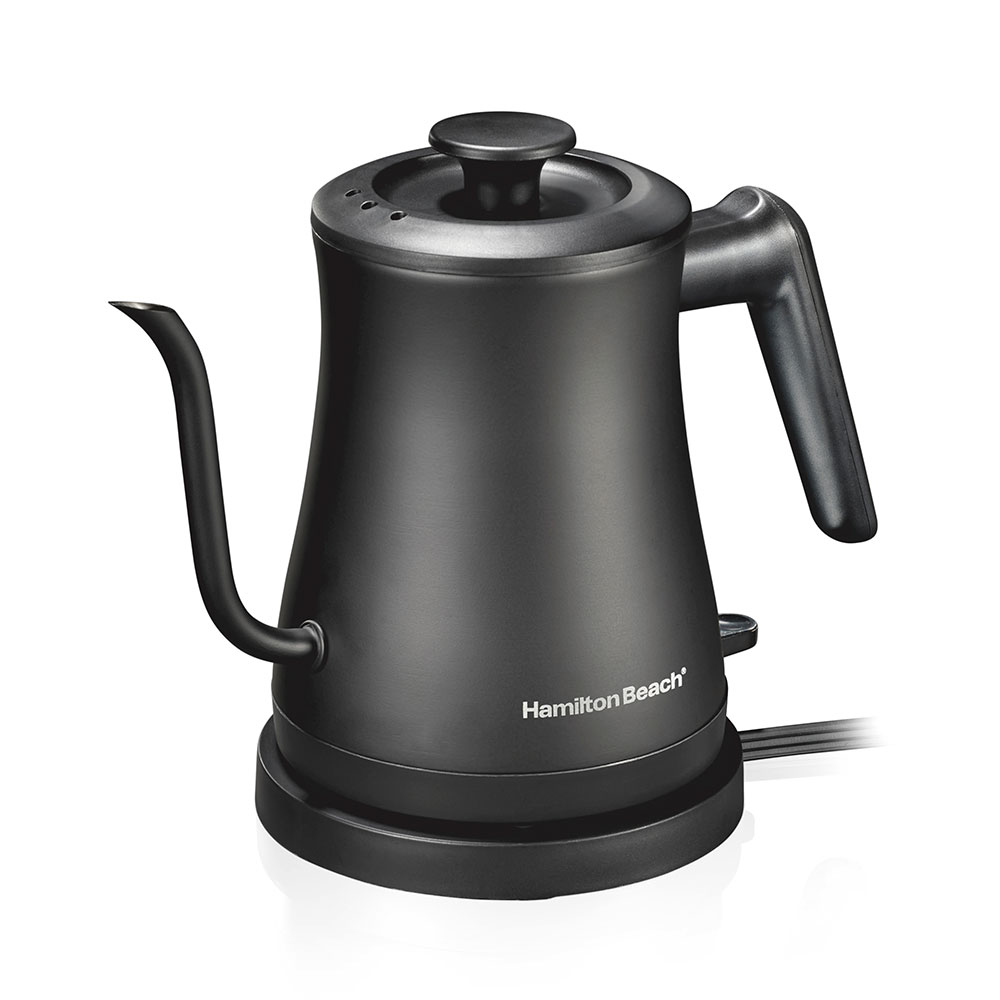
The Hamilton Beach 41045 is a useful choice for someone who wants gooseneck pouring in a particularly small electric kettle and is satisfied with a straightforward boil cycle. Hamilton Beach markets its capacity as 0.6 liter, while the manual marks the maximum as 20 ounces or 591 milliliters. It is better suited to one modest brewing task than several large drinks. The deciding limitation is that the slender spout comes without selectable temperatures or a holding mode.
Pouring control is its purpose
The gooseneck shape is intended to direct a narrow stream more deliberately than a short general-purpose spout. That is useful when placing water over a small coffee bed or filling a vessel carefully. It is a design-based reason to choose this model, rather than a claim that we measured its flow, balance or drip behavior.
The pouring choice still has a tradeoff. If you mainly want to fill a large pot quickly, a general spout and larger capacity are more natural. A compact gooseneck can be excellent for an individual routine while making shared household service unnecessarily slow or requiring extra batches. Decide on the pouring task before treating a gooseneck as a universal upgrade.
A normal minimum of 237 milliliters
The manual requires at least eight ounces, stated as 237 milliliters, and limits the maximum to 20 ounces or 591 milliliters. These are the exact supplied figures rather than a universal cup conversion. The marketed 0.6-liter size is a rounded capacity description; use the actual MAX line when filling. This review conservatively uses 0.591 liter as the manual's explicit maximum for matching.
A 250-milliliter small-fill requirement therefore fits the documented range. A 200-milliliter requirement does not. The maximum also needs to cover any water used to warm the brewer or rinse filter paper, not just the finished drink. If your brewing routine needs 600 milliliters of actual water, the rounded marketing label is not permission to exceed the marked maximum.
A single switch sets the heating routine
Remove the lid, fill the jug, replace the lid with its vent holes toward the spout and put the kettle on the powered base. Pressing the switch starts heating and lights the red indicator. It switches off after boiling. The manual describes shutoff 30–90 seconds after the water boils, rather than an immediate response at one measured temperature.
There are no lower-temperature presets, numerical display or active Keep Warm controls. A gooseneck describes the pouring route, not temperature regulation. If your coffee recipe requires selecting and holding a lower setpoint, a more elaborate gooseneck is the right comparison. Waiting for boiled water to cool is your own method rather than an offered control setting.
A removable lid and a metal interior
The lid lifts off completely, which makes filling a small vessel easier than working beneath a hinge. It must still be replaced properly before heating, with the orientation described in the manual. Hamilton Beach identifies a stainless steel, BPA-free interior. That description should not be expanded into a certification that every component in the full water path is metal.
The jug lifts from the base for serving, while the base's cable stays at the counter and stores underneath afterward. Cord-free serving does not provide heating away from mains power. The US product reference specifies a 1200-watt heater. This assessment does not turn that figure into an invented boil time or claim that it is faster than every larger kettle.
Who benefits from the smaller design?
Choose the 41045 when your whole brewing job fits inside the marked maximum and a simple boiling endpoint is enough. Cool and unplug it before wiping or descaling, keep the electrical base dry and use it for water. Tea leaves, coffee and other ingredients belong in a separate brewing vessel. The kettle's small size does not remove the need to follow its minimum fill.
The Chefman Fast Boil 0.8-liter gooseneck is a useful comparison when you want a similar boiling routine with more batch capacity. A temperature-selectable gooseneck better suits numerical recipes and water held ready between pours. The 41045's appeal is its small, clearly bounded task rather than an expectation that it can perform every brewing routine.
Key details at a glance
| Controlled-pour gooseneck | Yes |
|---|---|
| General-purpose spout | No |
| Selectable temperature | No |
| Live temperature readout | No |
| Completely removable lid | Yes |
| External water-level window | No |
| Tea infuser included | No |
| Nominal maximum capacity | 0.59 L |
| Documented minimum fill | 237 mL |
| Rated input power | 1200 W |
| Body/base width | 7.8 in |
| Body/base depth | 5.5 in |
| Body/base height | 7.9 in |
| Pouring arrangement | Narrow gooseneck for directed pouring; no personally measured flow claim. |
| Temperature controls | Single switch boils; red LED shows operation. |
| Holding routine | No active hold. |
| Water-contact material details | Maker stainless/BPA-free interior claim; no complete material certification. |
| Care and access | Lift-off lid with vents oriented toward spout; cool, wipe and descale. |
| Electrical edition and base | US exact reference, 1200 W; manual max 20 oz/591 mL used conservatively. |
Use the exact model’s instructions for operating limits, supplied equipment and version differences.
Sources for this assessment
Find a kettle for your daily routine.
Compare pouring style, batch capacity, temperature controls and the details that matter to you.