
Your needs, this model
Does it fit your priorities?
Can I heat a 250 mL fill?
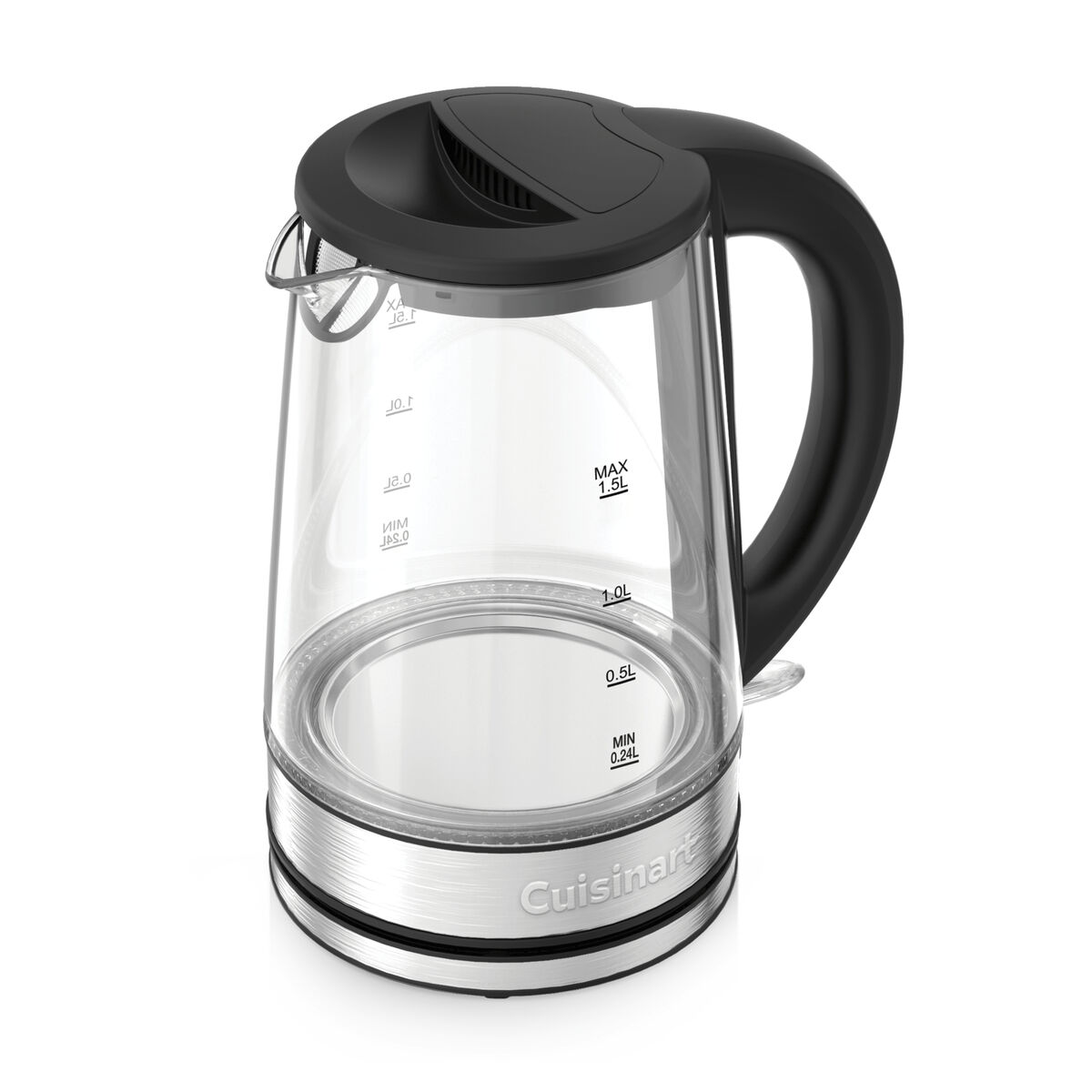
The official exact-model hero marks MIN 0.24 L, so 250 mL is above that marked minimum.
Explore this need in the finder →Can it heat a 1.5 L batch?
Yes. 1.5 L is the marked maximum.
Explore this need in the finder →Can I select exactly 80°C?
No selected-temperature route is documented for this boiling configuration.
Explore this need in the finder →A glass kettle for a straightforward boiling routine
The Cuisinart Clear GK-15 makes most sense when the job is filling a mug, a teapot or an instant-food container with boiled water. Its 1.5-liter glass jug, short spout and hinged lid are a practical combination for that routine. The deciding limit is temperature control: this is the documented boiling configuration in the Clear range. A shopper who needs to choose a lower brewing temperature should make that requirement explicit before choosing it.
The useful reason to consider the GK-15 is its balance between a substantial maximum and a small marked minimum. A larger jug does not force you to fill it completely. Cuisinart advertises a one-cup marking, and the exact official product image provides a more precise reference: the lowest mark says MIN 0.24 L. That is a documented 240 mL minimum, rather than a conversion from an unspecified cup size.
The fill scale matters more than the headline capacity
A required 250 mL fill therefore sits above the visible minimum, while a 1.5 L batch reaches the maximum. These are different questions. Maximum capacity decides whether one cycle can supply your whole serving job; minimum fill decides whether you can heat only a small amount within the maker's marks. The GK-15 supports both a relatively small fill and a family-sized quantity, provided your actual total stays inside that range.
Count the water your own cups and teapot use instead of treating 1.5 L as a fixed number of drinks. A large mug can consume much more than a small teacup, and warming a separate vessel uses additional water. The clear jug lets you inspect the level from outside, which is helpful when another household member has already filled it. It also makes mineral deposits visible when it is time to check the interior.
A light is an operation signal
Cuisinart describes blue illumination during heating or boiling. That tells you something about operation; it does not provide a live numerical water temperature or a chosen tea setting. If your normal sequence is boil, pour and finish, there is little reason to add controls you will not use. If a recipe depends on a selected lower temperature, a blue light cannot replace that control.
Active holding is not established by the exact reference read for this model. Do not choose it on the assumption that it will keep a selected temperature ready throughout a long breakfast. Passive warmth remaining in the water is a different behavior from a powered holding mode. In the questionnaire, a required holding mode or selectable temperature changes the shortlist in a way that the GK-15's published configuration cannot satisfy.
Everyday pouring and access
The general spout suits transferring water into a cup or teapot. Cuisinart calls it drip-free, but that is a manufacturer claim rather than a result from our own pouring test. Its shape also does not make it a gooseneck. A coffee routine centered on a narrow, directed stream should start with that pouring requirement instead of relying on the fact that any kettle can deliver hot water.
The lid opens on a hinge with one-handed operation, and the jug lifts from a 360-degree powered base. Those details suit filling and returning the kettle from different directions. The lid remains attached, so it does not meet a requirement for a lid that lifts off completely. Allow the kettle to cool before accessing the opening for care. Glass construction alone does not establish that every water-contact component is glass or metal.
Who should choose it?
Choose the GK-15 for visible filling, a verified small minimum and general boiling up to 1.5 L. Choose by the actual electrical edition on the package; the material read establishes an official US consumer reference but does not publish a numerical wattage or voltage. This assessment makes no boil-speed, noise or durability measurement.
For a different routine, the Cuisinart CPK-17P1 is a useful comparison when temperature presets and holding matter. That added control is valuable only if it solves your own heating job. The GK-15's appeal is easier to judge once the needed batch, minimum fill and control routine are settled. See the exact Cuisinart GK-15 reference for its current model identity and gallery.
Key details at a glance
| Controlled-pour gooseneck | No |
|---|---|
| General-purpose spout | Yes |
| Selectable temperature | No |
| Live temperature readout | No |
| Completely removable lid | No |
| External water-level window | Yes |
| Tea infuser included | No |
| Nominal maximum capacity | 1.5 L |
| Documented minimum fill | 240 mL |
| Pouring arrangement | Short general spout; maker drip-free claim is not a personal pouring test. |
| Temperature controls | Blue light indicates operation; no selected-temperature control in the documented configuration. |
| Holding routine | No active hold arrangement established by the exact reference. |
| Water-contact material details | Glass jug; complete water-contact material specification not established. |
| Care and access | Hinged one-handed lid; cool before access and follow the supplied care instructions. |
| Electrical edition and base | Official US consumer reference; exact voltage and wattage not published in the material read. |
Use the exact model’s instructions for operating limits, supplied equipment and version differences.
Sources for this assessment
Find a kettle for your daily routine.
Compare pouring style, batch capacity, temperature controls and the details that matter to you.