
Your needs, this model
Does it fit your priorities?
Can I require a visible water level and 1.5 L capacity?
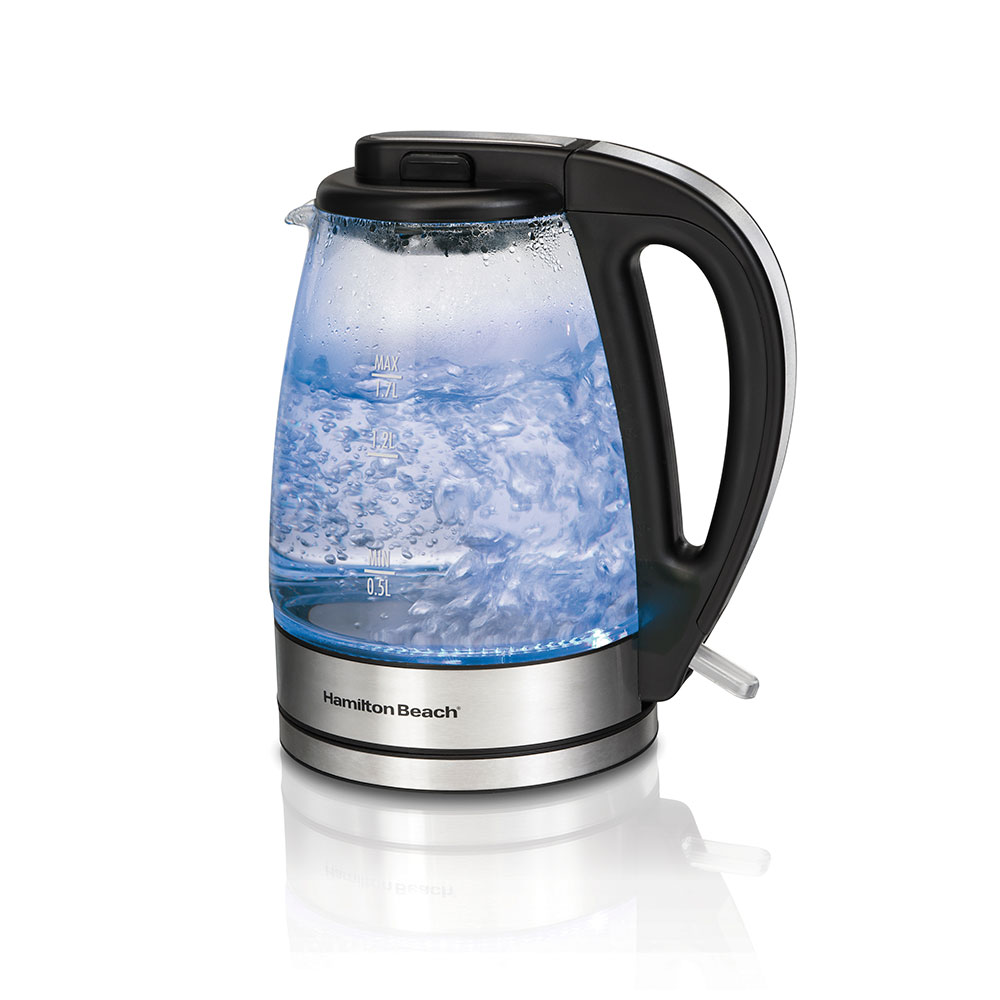
Yes. The glass vessel is marked and holds up to 1.7 L.
Explore this need in the finder →Can it automatically stop at 90°C?
No. The normal cycle is automatic boiling.
Explore this need in the finder →Does a half-liter fill fit the guide?
Yes. The normal range is 0.5–1.7 L.
Explore this need in the finder →A family-size glass jug for water that will be poured soon
The Hamilton Beach 40869G is a straightforward choice when your daily task is boiling water for several cups, a pot or a separate food-preparation vessel. Its 1.7-liter glass body lets you see the fill, and a single switch starts heating. The most useful reason to choose it is that uncomplicated combination of capacity and visibility. Its limitation is the absence of numerical temperature selection and an active warming interval for later servings.
What its blue illumination means
The product page describes soft blue light when the kettle is on and heating. This is a convenient way to see the operating state across a counter. It is not a live temperature readout, and there are no documented lower-temperature buttons in the complete operating guide. The kettle's normal automatic endpoint is boiling.
That makes the 40869G appropriate for someone comfortable heating water first and preparing the drink elsewhere. A recipe requiring a particular lower setpoint is a different need. Manually switching off the kettle or allowing boiled water to cool does not establish an offered setting that a finder should promise. Similarly, automatic shutoff does not imply that a second cup will be held at the original temperature.
Check both ends of the fill range
The maker specifies up to 1.7 liters, and its linked manual requires at least 0.5 liter. The maximum works well for a larger-batch requirement. The minimum is relevant if you normally drink a single small cup and want to heat no extra water. Match the kettle's normal range to your smallest frequent batch as well as to occasional larger servings.
The transparent body makes it easy to inspect the level. Keep within the actual marks rather than judging capacity from the amount of unused glass above them. The upper space is needed for boiling. Boil-dry protection addresses accidental insufficient water; it is not a substitute for respecting the half-liter minimum in everyday use.
Boiling behavior and sensible expectations about speed
The official US page lists a 1500-watt heater. That gives an electrical identity for this reference, but is not a measured boil-time result. Water amount and starting temperature affect how long the cycle takes. This review does not infer a full-kettle time from wattage or repeat another model's small-batch speed claim as a result for this one.
The current guide describes automatic shutoff 30–90 seconds after water boils. Keep the lid securely closed and allow the normal cycle to complete. A brief continued boil is part of that operation, not a selectable timer. If you need water to stay ready across a half-hour breakfast, choose a model with a documented Keep Warm routine instead of assuming it from the automatic shutoff language.
A serving spout and an in-place scale filter
The short general-purpose spout is suited to mugs and teapots. A gooseneck better addresses the separate task of slowly placing a narrow stream over coffee grounds. The jug lifts from its powered base for serving, so the cable stays on the counter. That makes carrying and refilling convenient while still requiring mains power for heating.
The product page describes a built-in mesh scale filter. The linked guide identifies a nonremovable filter, cleaned gently in place after cooling. Do not pull it out as if it were a removable cartridge from another kettle. Its purpose is to intercept suspended deposits on their way through the spout; it is not a tea infuser or a method for removing dissolved hardness.
Care is part of the glass-kettle choice
Visible water also means visible mineral deposits. Empty the vessel after use and descale according to the supplied procedure when needed. Unplug and cool it before cleaning, keep electrical connections dry and avoid abrasive pads. Glass sides with stainless accents should not be expanded into an all-metal water-path claim, and this assessment makes no claim that the body remains cool to touch.
Choose the exact 40869G package if you want a clear, larger-capacity kettle for boil-and-serve use. The Breville Crystal Clear is a useful alternative when its lid and removable-filter arrangement better suit your care routine. Temperature selection, holding and gooseneck pouring are separate reasons to look at a different design. Decide which of those would change how you make the drink before choosing from similar-looking glass kettles.
Key details at a glance
| Controlled-pour gooseneck | No |
|---|---|
| General-purpose spout | Yes |
| Selectable temperature | No |
| Live temperature readout | No |
| Completely removable lid | No |
| External water-level window | Yes |
| Tea infuser included | No |
| Nominal maximum capacity | 1.7 L |
| Documented minimum fill | 500 mL |
| Rated input power | 1500 W |
| Body/base width | 6.2 in |
| Body/base depth | 8.6 in |
| Body/base height | 9.9 in |
| Pouring arrangement | General-purpose spout. |
| Temperature controls | Single boil switch; blue illumination signals heating. |
| Holding routine | No active warming. |
| Water-contact material details | Glass vessel and stainless accents; no full water-path certification. |
| Care and access | Current linked guide describes brushing nonremovable mesh in place and periodic descaling. |
| Electrical edition and base | Exact US official page specifies 1500 W. |
Use the exact model’s instructions for operating limits, supplied equipment and version differences.
Sources for this assessment
Find a kettle for your daily routine.
Compare pouring style, batch capacity, temperature controls and the details that matter to you.